


All Products
-
Nuclear Radiation Protection
-
Nuclear Radiation Detector
-
Copper Foil Shielding
-
RF Shielded Doors
-
RF Shielded Windows
-
Radiation Protection Lead Glass
-
Non Magnetic Tool Kit
-
RF Shielded Chamber
-
Honeycomb Waveguide Air Vents
-
Conductive Adhesive Copper Tape
-
Copper Wire Mesh
-
X Ray Lead Glass
-
EMI Shielding Gasket
-
Electrically Conductive Fabric
-
Radiation Protection Door
-
Radiation Protection X Ray
-
Faraday Cage MRI
-
Copper Wire Wool
-
MRI LED Lighting
-
Non Magnetic Wheelchair
-
Non Magnetic Stretcher
-
 AnasBrass honeycomb vent Looks Very Nice
 -
 SatheeshMRI/RF doors are shining with handles, Thank you My friend.
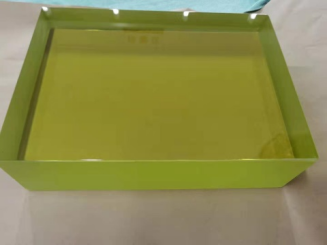
Density 5.5 G/cm³ X Ray Protection Glasses with Superior Shielding Performance for Medical and Industrial Applications

| Brand Name | Jovi |
|---|---|
| Certification | CE |
| Model Number | 1-cf-15 |
| Document | Lead glass specification.pdf |
| Minimum Order Quantity | 1 Pc |
| Price | $1230/pc-$3780/pc |
| Packaging Details | In Wooden Case Or Customized |
| Delivery Time | 5-8 Work Days |
| Payment Terms | T/T |
| Supply Ability | 2000 Pcs Per Month |
Product Details
| Density | 5.5 G/cm³ | Light Transmission | 84-86% |
|---|---|---|---|
| Optical Distortion | < 3 Arcminutes | Radiographic Quality | ≥99.97% |
| Lead Equivalence | 2.5-4.0 Mm Pb | Surface Roughness | < 10 Nm Ra |
| Highlight | 5.5G/Cm³ X-Ray,Glass Industrial,Professional Medical Industrial |
||
Product Description
Jovvi Lead Glass for Nuclear Medicine Departments – Comprehensive Technical Description
1. Manufacturing & Physical Principles
1.1 What Is Lead Glass?
Lead glass is not simply ordinary glass with lead added. It is a homogeneous inorganic material formed by melting silica (SiO₂), lead oxide (PbO), and other modifiers at approximately 1,350°C. The lead oxide content typically ranges from 55% to 72% by weight, which gives the glass its radiation shielding properties while maintaining transparency.
1.2 Why Lead?
Lead has a high atomic number (Z = 82). High‑Z materials interact with X‑rays and gamma rays primarily via the photoelectric effect, where an incoming photon is completely absorbed. The probability of photoelectric absorption is proportional to Z⁴/E³. For 140 keV gamma rays (⁹⁹ᵐTc), lead’s absorption coefficient is approximately 10 times higher than that of calcium (Z=20, the main component of concrete) and 100 times higher than that of carbon (Z=6, in plastic).
Key physical formula – Linear attenuation coefficient μ ≈ ρ × (Z⁴/E³). Jovvi lead glass achieves μ = 2.5–3.5 cm⁻¹ at 140 keV, compared to μ = 0.15 cm⁻¹ for ordinary window glass.
1.3 Optical vs. Shielding Trade‑off
Adding lead oxide reduces light transmission. Jovvi balances this by:
-
Using high‑purity silica (99.9%) to minimize impurities that cause haze
-
Controlling redox state (Fe²⁺/Fe³⁺ ratio) to maintain neutral gray‑green tint
-
Polishing both surfaces to <10 nm roughness (standard float glass: 50–100 nm)
Result: A 2.8 mm Pb equivalent panel (physical 16 mm thick) transmits 82–84% of visible light – comparable to a typical window screen.
2. Key Quality Parameters for Nuclear Medicine
2.1 Lead Equivalence Accuracy
Nominal value (e.g., 2.5 mm Pb) must be achieved across the entire panel, not just at the center. Jovvi measures 9 points on a 1.2×0.8 m panel. Maximum deviation: ±0.05 mm Pb (equivalent to <2% variation).
2.2 Radiation‑Induced Browning
Under gamma exposure, pure lead glass forms color centers – trapped holes in the glass network that absorb blue light, causing yellow‑brown discoloration. Jovvi adds 0.8–1.2 wt% cerium oxide (CeO₂), which traps holes before they become stable color centers.
Test data: 1,000 hours continuous ⁶⁰Co gamma irradiation (1 Gy/hour, ⁹⁹ᵐTc equivalent of 10 years typical workload). Jovvi nuclear grade: ΔE = 2.1 (barely detectable). Generic lead glass without CeO₂: ΔE = 11.7 (severe brown, 30% light loss).
2.3 Bubble & Inclusion Specification
Bubbles >0.5 mm reduce local shielding effectiveness (glass density drops). In hot lab viewing ports, bubbles over syringe graduations cause dosing errors.
| Application | Jovvi Nuclear Grade Specification | Industry Typical |
|---|---|---|
| SPECT/CT control room | Bubbles >0.5 mm: ≤1 per 100 cm² | ≤3 per 100 cm² |
| Hot lab (central 100 mm diameter) | Zero bubbles >0.3 mm | Not specified |
| PET‑CT composite | Zero bubbles >0.2 mm in optical bond layer | Not applicable |
2.4 Mechanical Strength
Nuclear grade glass is annealed (slowly cooled) to relieve internal stress. Residual stress measured by polariscope: <20 nm/cm (ASTM F218 allows 35 nm/cm). Low stress prevents spontaneous fracture during thermal cycling (e.g., air conditioning on/off, winter/summer).
Edge strength: All edges are chamfered (0.5×45°) and ground to 400 grit. Chemical strengthening (ion exchange) available for hot lab small panels – increases edge strength by 2×.
3. Application Scenarios in Nuclear Medicine – Detailed
3.1 SPECT Room (⁹⁹ᵐTc, 140 keV)
Typical setup: Gamma camera rotates 180–360° around patient. Control booth located 3–5 meters away.
Jovvi specification:
-
Lead equivalence: 2.5–3.0 mm Pb
-
Physical thickness: 14–18 mm
-
Panel size: 1,200×800 mm (sufficient to view entire gantry)
-
Light transmission: 82–84%
Special design feature: Wide viewing angle – transmission drop <10% at 45° off‑axis. Technologists can view patient while seated at console without turning body.
3.2 PET‑CT Room (¹⁸F‑FDG, 511 keV)
The challenge: 511 keV photons have a half‑value layer in lead of ~4 mm. A 5 mm Pb monolithic glass panel (28 mm thick) weighs 110 kg/m² and still transmits ~50% of 511 keV.
Jovvi composite solution:
-
Front: 2.5 mm Pb glass (15 mm thick)
-
Middle: 10 mm lead acrylic (2.5 mm Pb eq. at 140 keV, 1.5 mm at 511 keV)
-
Rear: 2.5 mm Pb glass (15 mm thick)
-
Total 511 keV transmission: <15%
-
Weight: 70 kg/m² (36% lighter than monolithic)
Optical bonding: The three layers are bonded with UV‑stable adhesive. No haze, no double images, no delamination under thermal cycling (–10°C to +40°C).
3.3 Hot Lab (Radiopharmacy) Viewing Port
Setup: Lead glass panel (typically 400×300 mm or 500×400 mm) mounted in fume hood or laminar flow cabinet.
Jovvi specification:
-
Lead equivalence: 2.5 mm Pb (sufficient for short handling times)
-
Physical thickness: 14 mm
-
Anti‑reflection (AR) coating on both sides – eliminates glare from hood lights
-
Central clear zone: 150 mm diameter with zero bubbles >0.2 mm
Ergonomic benefit: Pharmacist reads 0.01 mL syringe graduations at 30 cm distance without eye strain.
3.4 Patient Isolation Room (High‑dose ¹³¹I Therapy)
Setup: Nurse station window into patient room. Patient receives 200–800 mCi ¹³¹I (364 keV gamma).
Jovvi specification:
-
Lead equivalence: 3.5–4.0 mm Pb
-
Physical thickness: 20–24 mm
-
Panel size: 800×600 mm (adequate for observation)
-
Light transmission: 76–80%
Critical requirement: Zero distortion – nurse must accurately assess patient consciousness, breathing, and skin color. Jovvi provides optical flatness certificate (<0.1 mm over 1 m).
3.5 Corridor Viewing Between Multiple Rooms
Large nuclear medicine departments often have several control booths along a corridor. Inconsistent glass tint creates visual confusion.
Jovvi solution: Batch‑matched glass – all panels from same melt batch. Jovvi provides color consistency certificate (ΔE <1.0 between any two panels).
4. Production Assurance & Certification
4.1 Raw Material Traceability
Each batch of lead oxide (PbO) is assayed for impurities: arsenic (<0.01%), antimony (<0.005%), iron (<0.02%). Certificates retained for 20 years.
4.2 In‑Process Quality Checks
| Stage | Check | Rejection Criteria |
|---|---|---|
| Melting | Temperature, redox ratio | ±10°C from setpoint |
| Casting | Thickness laser scan | >±0.5 mm |
| Annealing | Stress (polariscope) | >20 nm/cm |
| Cutting | Dimensional tolerance | >±0.5 mm |
| Polishing | Surface roughness | >10 nm Ra |
4.3 100% Final Inspection (Every Panel)
-
X‑ray transmission imaging (80 kV, 2 mA) – reveals lead striations, bubbles >0.2 mm, internal cracks.
-
Attenuation measurement – 140 keV source (⁹⁹ᵐTc or filtered X‑ray). 9‑point grid. Pass if all points within ±0.05 mm Pb of nominal.
-
Optical inspection – Light box (10,000 lux) – bubbles, scratches, striae.
-
Flatness – Laser interferometer – <0.1 mm over 1 m.
4.4 Certifications
-
ISO 13485:2016 – Medical devices quality management
-
ISO 9001:2015 – General quality management
-
CE marking – Class I medical device (EU)
-
FDA 510(k) – Available for X‑ray shielding glazing
-
RoHS 3 – Compliant (lead exempted for medical necessity)
4.5 Documentation Delivered with Each Panel
-
Certificate of Conformance (serial number, Pb eq., dimensions)
-
140 keV attenuation test report (9‑point grid)
-
CeO₂ content certificate (proof of browning resistance)
-
Bubble inspection photograph (central zone for hot lab panels)
-
Installation manual (torque specs, gasket type, lead tape application)
Recommended Products
