


All Products
-
Nuclear Radiation Protection
-
Nuclear Radiation Detector
-
Copper Foil Shielding
-
RF Shielded Doors
-
RF Shielded Windows
-
Radiation Protection Lead Glass
-
Non Magnetic Tool Kit
-
RF Shielded Chamber
-
Honeycomb Waveguide Air Vents
-
Conductive Adhesive Copper Tape
-
Copper Wire Mesh
-
X Ray Lead Glass
-
EMI Shielding Gasket
-
Electrically Conductive Fabric
-
Radiation Protection Door
-
Radiation Protection X Ray
-
Faraday Cage MRI
-
Copper Wire Wool
-
MRI LED Lighting
-
Non Magnetic Wheelchair
-
Non Magnetic Stretcher
-
 AnasBrass honeycomb vent Looks Very Nice
 -
 SatheeshMRI/RF doors are shining with handles, Thank you My friend.
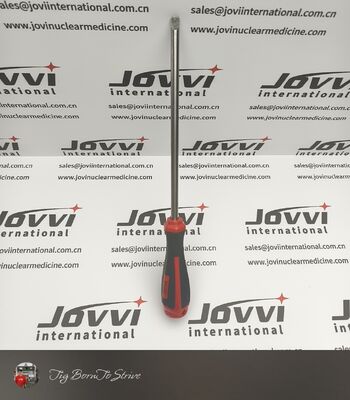
Grade 5 Titanium Alloy MRI Safe Tool Kit with Non-Magnetic Properties and Ergonomic Plastic Handle

| Brand Name | Jovi |
|---|---|
| Certification | ISO9001 |
| Model Number | 1-cf-7 |
| Document | JVVM-NMT-Series SPE and Quo...on.pdf |
| Minimum Order Quantity | 1set |
| Price | $2580~$3290 |
| Packaging Details | Carton&wooden Box |
| Delivery Time | 7-14days |
| Payment Terms | T/T |
| Supply Ability | 300 Set / Month |
Product Details
| Material Composition | ≥90% Titanium Alloy (Grade 5, Ti-6Al-4V) | Magnetic Susceptibility | χ < 5 × 10⁻⁶ (SI) |
|---|---|---|---|
| Hardness | 38-42 HRC | Tool Count | 15 |
| Corrosion Resistance | High | Case Material | Hard Plastic |
| Highlight | Ergonomic Handle Tool Kit,Premium Tool Kit Mri,Professional Non-Magnetic Titanium |
||
Product Description
Jovvi titanium tool sets are precision-engineered specifically for MRI engineering environments where ferromagnetic tools are strictly prohibited. Each tool is manufactured from ≥90% titanium alloy (Grade 5, Ti-6Al-4V), with the remaining non-ferromagnetic components made from brass, beryllium copper, or bronze. The result is a family of wrenches, screwdrivers, and hex keys that are completely safe inside magnetic fields up to 7 Tesla – no image artifacts, no projectile risk, no ferromagnetic debris.
Raw Material – The Foundation of MRI Safety
The production process begins with certified Ti-6Al-4V bar stock. Jovvi sources only from ISO 13485-certified suppliers who provide a Mill Test Report (MTR) with every shipment. Each MTR confirms:
- Titanium content: ≥90% by mass (typically 90–91%)
- Aluminum: 5.5–6.75%
- Vanadium: 3.5–4.5%
- Iron: <0.25% (critical for non-magnetic property)
- Oxygen: <0.2%
- No ferromagnetic inclusions detectable
Before any bar stock enters the machining center, Jovvi performs incoming XRF (X-ray fluorescence) verification. An XRF spectrometer scans the material and confirms titanium percentage. Any bar falling below the 90% threshold or showing iron content >0.25% is rejected and returned to the supplier. This step ensures that every tool – from the smallest micro hex key to the largest torque wrench – starts with compliant material.
Manufacturing Steps – Precision at Every Stage
Step 1: CNC Machining
- Wrenches – 5-axis CNC milling from forged or bar-stock titanium. Jaw opening tolerance: ±0.05 mm. Parallelism: <0.1 mm.
- Screwdrivers – Swiss-type CNC lathe for blades; milling for tip geometry. Tip concentricity: <0.05 mm. Blade straightness: <0.1 mm per 100 mm.
- Hex keys – CNC grinding from drawn titanium wire (hexagonal cross-section achieved by drawing through dies). Across-flats tolerance: ±0.02 mm. Corner radius: <0.05 mm.
All cutting is performed with carbide tooling (non-contaminating) and non-ferromagnetic coolant, which is recycled in a closed-loop system with zero discharge.
Step 2: Heat Treatment (Age Hardening)
Titanium in its annealed state is too soft for hand tools (approximately 34 HRC). Jovvi applies a two-step heat treatment:
- Solution treatment – 955°C for 1 hour, water quench. This dissolves alloying elements uniformly.
- Aging – 480°C for 4 hours, air cool. This precipitates fine alpha-beta phases, achieving final hardness of 38–42 HRC.
Each batch is tested: 3 samples per 100 pieces undergo Rockwell hardness testing. Results outside 38–42 HRC trigger re-heat treatment or scrapping.
Step 3: Surface Finishing
- Bead blasting – Glass beads (100–200 mesh) at 60 psi create a uniform matte finish and remove machining marks.
- Passivation – Nitric acid bath (20% HNO₃, 30 minutes, 50°C) restores the natural titanium oxide layer, ensuring corrosion resistance against saline, contrast media, and cleaning agents.
- Laser marking – Fiber laser annealing (20W, 1064 nm) creates permanent high-contrast marks. No paint, no ink, no material removal.
Step 4: 100% Magnetic Susceptibility Testing
Every finished tool passes through a SQUID magnetometer (Superconducting Quantum Interference Device) per ASTM F3042. Test fields: 0.5 T, 1.0 T, and 3.0 T. Acceptance criterion: χ < 5 × 10⁻⁶ (SI) – 200 times stricter than the ASTM requirement. Any tool exceeding this limit is scrapped; no rework is attempted.
Step 5: Final Inspection and Packaging
Each tool undergoes dimensional inspection (laser micrometer), tip geometry check (optical comparator at 50× magnification), and visual inspection (10× magnified LED). Tools are placed in custom foam inserts inside an ESD-safe ABS case with brass or plastic clasps (no steel hinges). The case is labeled “JOVVI Ti – MRI SAFE – DO NOT MIX WITH STEEL TOOLS.”
Batch Traceability and Documentation
Every Jovvi tool is laser-etched with:
- Batch number (links to MTR, machining records, heat treatment log)
- Unique serial number
- “Ti ≥90%” composition mark
Each tool set includes a Certificate of Conformance listing all batch test results, magnetic susceptibility summary, and ISO 13485 reference. Customers can enter the serial number on Jovvi’s portal to download the complete production record.
Quality Assurance Summary
Jovvi operates under ISO 13485:2016 (medical device quality management). From certified raw material to finished laser-marked tool, every step is controlled, documented, and traceable. The result is a titanium tool set that MRI engineers can trust – not because we say so, but because we prove it on every tool.
Recommended Products
